Case study: how the town hall of Mackenheim became visible on ChatGPT
Ask ChatGPT how to contact the mayor of Mackenheim, a small French town, and it first cites pages of the town's own website, ahead of any directory or third-party site. That website is the one I built for the town hall.
This case study covers what was done, what it changed on Google and on ChatGPT, and what you can take from it for your own website. With the numbers, including the one that isn't perfect: I redid the test today, and the result varies from one test to the next.
Why this study, and why a town hall
A town hall is not a business, and I won't pretend otherwise. But the problem is the same for any website: someone asks an AI a question, and the AI cites only a few sources. Either your website is one of them, or it doesn't exist in the answer.
Mackenheim is my best-documented case, with numbers I can show. I use it as a point of comparison for your website, and I say each time what carries over and what doesn't.
The project
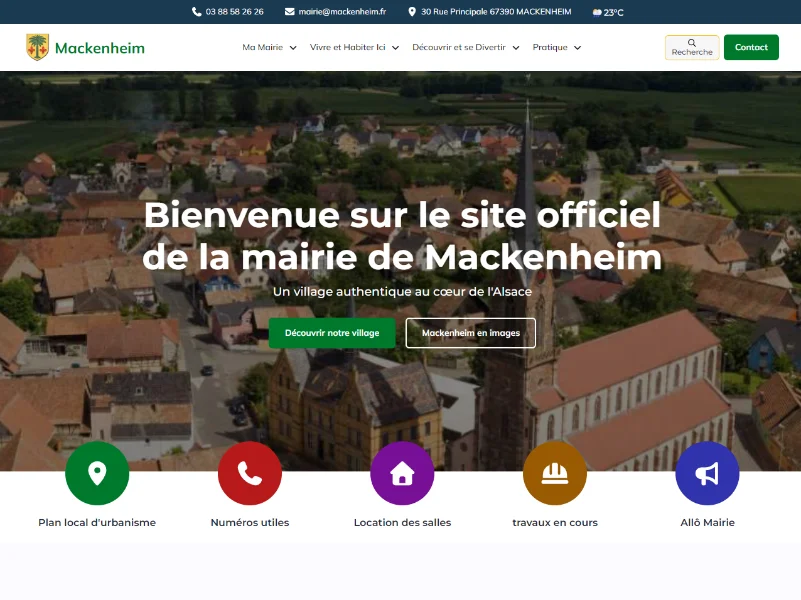
A 60-page institutional website, built in about four months and live since March 1, 2026, replacing the previous site. The goal: let every resident quickly find the information they need (opening hours, administrative procedures, hall rental, planning, elected officials) and make the site usable by everyone.
It includes site search and filters, a flip-through PDF viewer, a tool to adjust colors and text size, and a compliant cookie consent. It is built on Webflow, with a CMS.
What changed on Google
I compared Google Search Console figures before and after the redesign, as monthly averages.
One caveat: the two periods don't cover the same months (May to September 2025 for the old site, March to August 2026 for the new one). So this is not a controlled test, but the direction is clear: on average, the site moved from page 2 to the top of page 1.
The mayor, Christophe Ludaescher, puts it this way: "The statistics are there to prove that the site is constantly improving."
What changed on ChatGPT
I asked ChatGPT six typical resident questions, each in a new conversation, without naming any website. I asked them in French, since this is a French town:
- What are the opening hours of the town hall?
- How do I get a birth certificate?
- How do I register on the electoral rolls?
- How do I rent the municipal hall?
- How do I file a building permit?
- How do I contact the mayor?
I ran it three times on November 23, 2026, under three different conditions:
- from my ChatGPT account: the town's website is cited on 5 of the 6 questions;
- from a browser without an account: also 5 out of 6, but it isn't the same question that's missing;
- from another fresh browser, without an account: 6 out of 6.
So the town's website is cited on 5 to 6 of the 6 questions depending on the test, never on fewer than 5.
In the first test, for each cited question, ChatGPT points to the page that answers the question precisely, not to the home page:
- opening hours: the public reception page
- electoral rolls: the "Elections - registration and proxy" page
- hall rental: the rental rules page
- building permit: the planning page
- mayor: the town council page and the public reception page
Being cited doesn't mean being the only source. In all three tests, renting the hall, which is specific to the town, cites only the town hall's website. In the last test, only the town hall's website is cited as a link. In the other two, Service-Public.fr is often added, sometimes with the national planning portal for the building permit, and for official documents (birth certificate, electoral registration) it carries the most weight when the town's site is missing.
The tests don't miss the same question. The first misses the birth certificate: with my wording ("How do I get a birth certificate at the Mackenheim town hall?"), ChatGPT cites only Service-Public.fr, the national government portal. The second misses the electoral rolls, where only Service-Public.fr is cited, while the birth certificate this time cites the town hall's page. The third misses nothing. Another phrasing ("How do I go about getting a birth certificate in Mackenheim?") also cites the town hall, followed by Service-Public.fr. So every question is cited in at least two of the three tests, but never guaranteed: the result varies from one test to the next and from one wording to the next. One more reason to test several phrasings.
In July, I got 6 out of 6 on the same topics. Today, one test out of three finds that 6 out of 6 again, the other two don't. That is the most honest lesson of this study: an AI's answers change from one day to the next, from one browser to the next and from one wording to the next. A good result is never permanent, and you have to measure it several times.
Another encouraging sign: on a seventh question I hadn't prepared (about the town's Jewish cemetery), ChatGPT also cites the heritage page of the town hall's website, among other sources, and even points out on its own that the town has a page dedicated to this cemetery, with photographs and historical explanations. So the site is picked up beyond the six test questions.
What I take from it for your website
This case is not a magic recipe. Here are the principles I apply, and what they become for your website.
- One page for one question. ChatGPT cites the page that answers the question, not the home page. For your site: one page per service, per product or per question your customers ask, rather than a single home page that says everything.
- Accurate, up-to-date information. Opening hours, address, phone number: the AI repeats them as they are. A wrong detail on your site will be repeated in its answers.
- Tell machines who you are. Mackenheim's site declares in its code that it is a public organization, with its address and contact point (this is called structured data). For your site: same principle, with your organization's name, address, activity and contact.
- Let the robots in. Mackenheim's robots.txt file allows crawling, and a sitemap lists its 180 addresses. Check that yours doesn't block anything by mistake: add /robots.txt to your website address.
- Measure, then repeat. This six-question test takes about twenty minutes. Redo it every month, and ask each question two or three different ways: the wording changes the result.
The limits of this study
A town hall is a favorable case: the question "opening hours of the Mackenheim town hall" has only one good source, the town's own website. For your site, competition will be wider, and I won't promise you the same result. What I offer is the same method, and the same test to find out where you stand. I don't yet have a published case this complete in another sector: this one remains my best-documented example. One last limit: a test is only a snapshot. I ran three, under three different conditions: they give 5, 5 and 6 out of 6, and not on the same questions. Redo it several times before drawing conclusions.
To understand the mechanism in detail, read my article on how to get cited by ChatGPT. The full project is presented in my works.
Is your website cited by ChatGPT?
We run the test together, on the questions your future clients actually ask. 15 minutes by phone, no commitment.
Let's test your website's AI visibility →