A client is looking for an architect. Two years ago, they typed it into Google. Today, more and more often, they open ChatGPT and ask: « Can you recommend an interior architect in Montreal for a renovation? » And at that moment, only one thing matters: either the AI cites your practice, or it doesn't know you exist. In the second case, you simply aren't part of the conversation.
This new visibility battleground has a name: AEO, or Answer Engine Optimization. Optimizing your site not just to rank on Google, but to be cited as a source by answer engines: ChatGPT, Perplexity, Gemini, Google's AI overviews.
This is my specialty, and it's still almost untouched ground, especially in the architecture world. Here's what it is, why it matters now, and how it actually works.
SEO and AEO are not the same thing
SEO is about showing up in Google's list of blue links when someone searches. AEO is about being the source the AI cites when it writes its answer. Two different things: you can rank well on Google and be completely absent from ChatGPT's answers, and the other way around.
The core difference fits in one sentence: Google lists you, the AI recommends you. When ChatGPT says « for a renovation in Montreal, this practice is a solid reference », it's no longer one link among ten. It's a direct recommendation, phrased like advice. Far more powerful, and far rarer.
Why now, and why you
Two simple reasons. First, usage is exploding. More and more people ask an AI directly instead of scrolling through pages of results. This habit will only grow, and it changes how a future client finds you, or fails to.
Second, no one in your field is doing it yet. Everyone has heard of classic SEO, and the competition is fierce. AEO is a door that just opened, and almost no one is standing in front of it. The first practice in a city that AIs start citing gains a lead that's hard to catch. It's a window, and it's open right now.
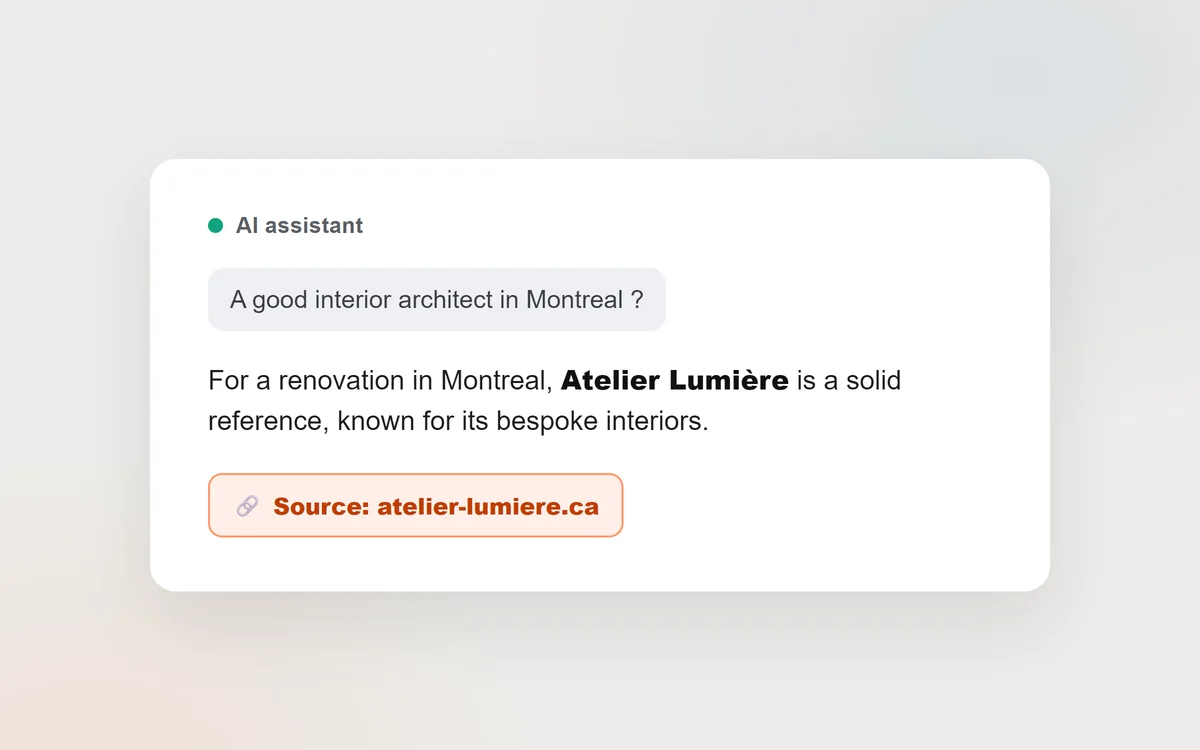
The proof: a site cited 6 times out of 6
I'm not selling a theory. On the site I built for the town of Mackenheim, I asked ChatGPT six real-world questions, exactly the kind a resident or a journalist would type. On all six, ChatGPT cites the Mackenheim site as a source.
That's not luck, and it's not limited to institutions. It's the result of precise content structuring, and it's repeatable on an architecture practice's site. You can see the details in my Mackenheim case study: the before/after SEO results and the 6/6 on ChatGPT.
How it works, in plain terms
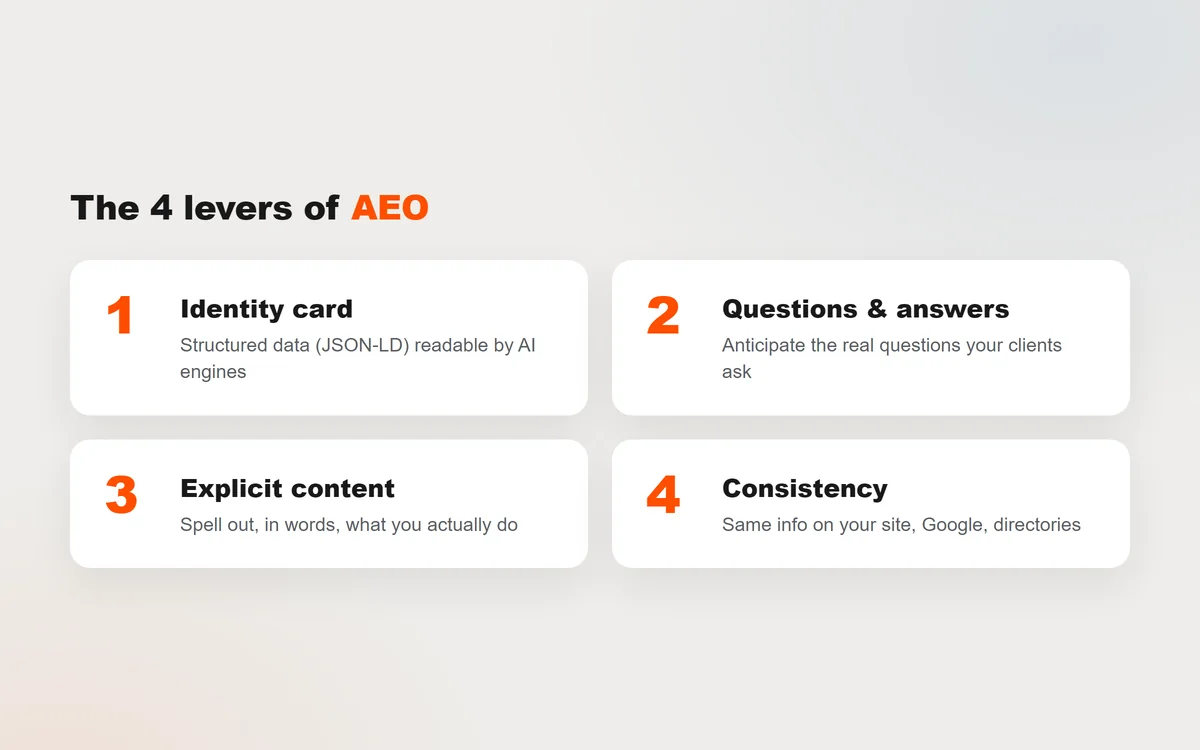
AEO isn't magic, and it isn't a trick. It's simply making your site crystal clear for a machine that reads, understands, and cites. Four levers, explained simply.
1. Give a machine-readable « identity card »
There's a format that's invisible to your visitors but read directly by Google and AIs: structured data (the « JSON-LD »). It's a small summary, behind the scenes, that states in plain terms who you are, where you are, what you do and your specialties. Without it, the AI has to guess from scraps. With it, it knows, and it can cite you with confidence.
2. Answer the real questions
AIs love clear questions and answers, because that's exactly the form in which they reply to their users. A page that answers the questions your clients actually ask (« How much does a project cost? », « How long does a renovation take? », « Do you work on extensions? ») gives the AI ready-to-cite material.
3. Say explicitly what you do
Here's the paradox of your craft: your images are stunning, but an AI can't infer your expertise from a photo. You have to spell it out: your project types, your service areas, your approach. What feels obvious to you has to be written down, because the machine only reads what's actually there.
4. Be consistent everywhere
AIs cross-check sources. If your site, your Google profile and your directory listings all say the same thing (same name, same address, same specialty), you send a trust signal. Contradictory information, on the other hand, breeds doubt and gets you dropped.
Test yourself in two minutes
Open ChatGPT and ask three questions, the way a client would: « a good interior architect in [your city] », « who should I trust for a renovation in [your city] », « which architecture practice for an extension in [your city] ». See whether your name comes up, or whether a link to your site is cited.
If you're never mentioned, you're invisible on this new channel, while the spot is still open for your competitors.
In short
SEO is still essential, and if your site has shaky foundations, start there (I cover this in my article on the 7 mistakes that make you invisible on Google). But a new door is opening alongside it, and it's nearly empty. Being cited by AIs is no longer science fiction: it's a matter of structure, clarity and method. AEO is about taking that spot now, before everyone else.
Do AIs cite you today?
I'll test your visibility on ChatGPT and show you exactly what to fix.
Test your AI visibility →