You have a beautiful portfolio, projects you're proud of, and yet when a client types « architect » and your city into Google, you're nowhere to be found. This isn't bad luck. It's almost always a matter of technical mistakes, invisible to the eye, that most architecture websites make.
I've audited around a hundred websites for architecture and interior design firms. The same problems keep coming back, over and over. Here are the 7 most common ones, explained simply, and more importantly, how to fix them.
1. Your page has no main heading
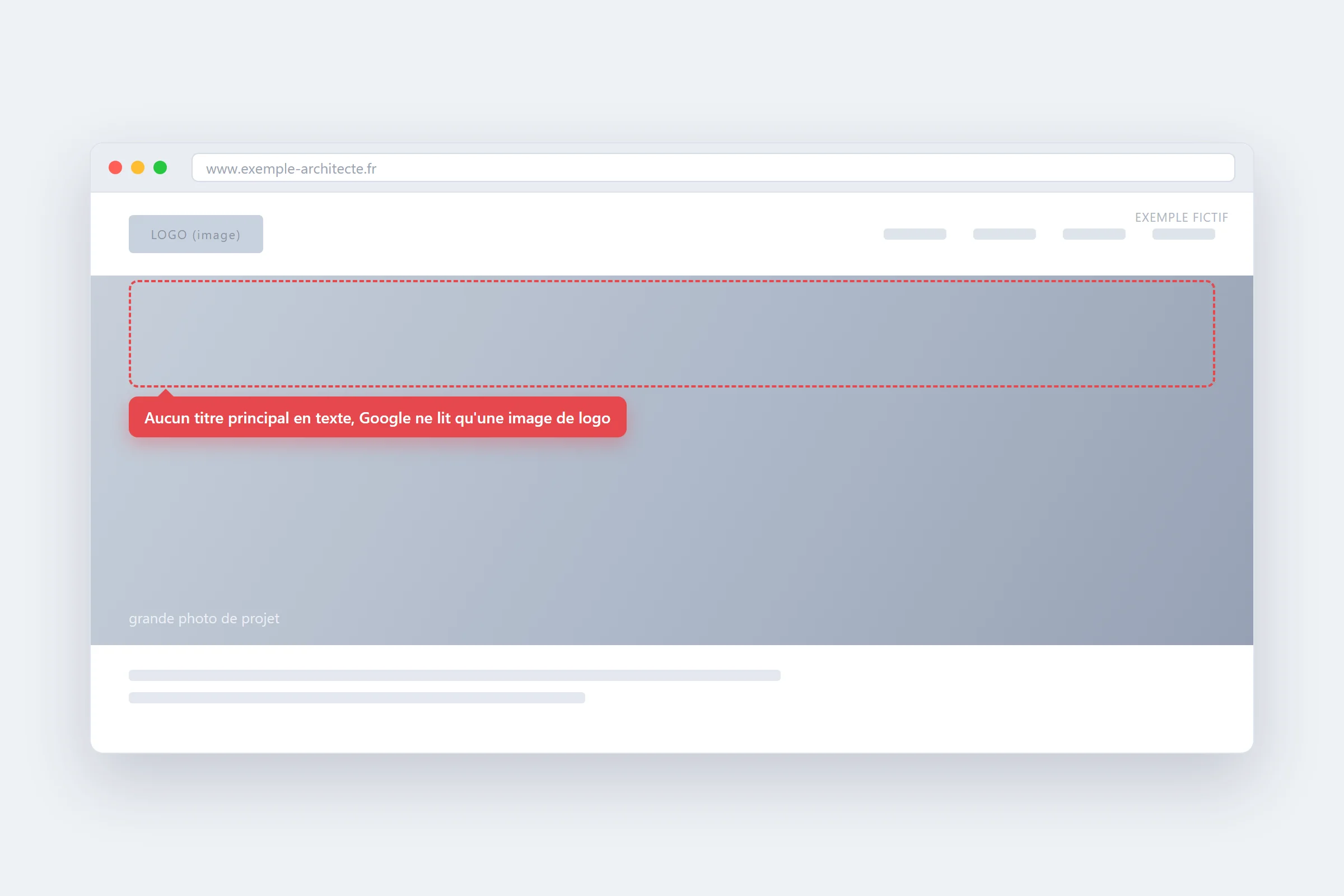
Google needs to understand, in one second, what each page is about. To do that, it reads the page's main heading first (what's technically called the « H1 »). It's the big line that announces the topic.
The problem: on many architecture websites I've analyzed, there is no main heading at all. Often the firm's name is shown as a logo image, with no text Google can read. As a result, to Google, your page is about nothing.
The fix: every page needs a real text heading, clear, that states what you do and where (for example « Architecture firm in London, contemporary homes and renovation »).
2. Your best images are invisible to Google
It's the cruel paradox of your profession: your portfolio IS your product, but Google can't see your images. It doesn't « look » at a photo, it reads the text description attached to each image (the « alt text »). Without that description, your work doesn't exist for it.
On the sites I audited, it's systematic: I've seen portfolios with 30 images out of 30 with no description, 12 out of 12, sometimes 50 photos without a single word. All the visual power of your work, lost for search.
The fix: every image needs a short description of what it shows (for example « Loft renovation in Bristol, open oak kitchen »). It's good for Google, and it's also an accessibility requirement.
3. Your website says almost nothing
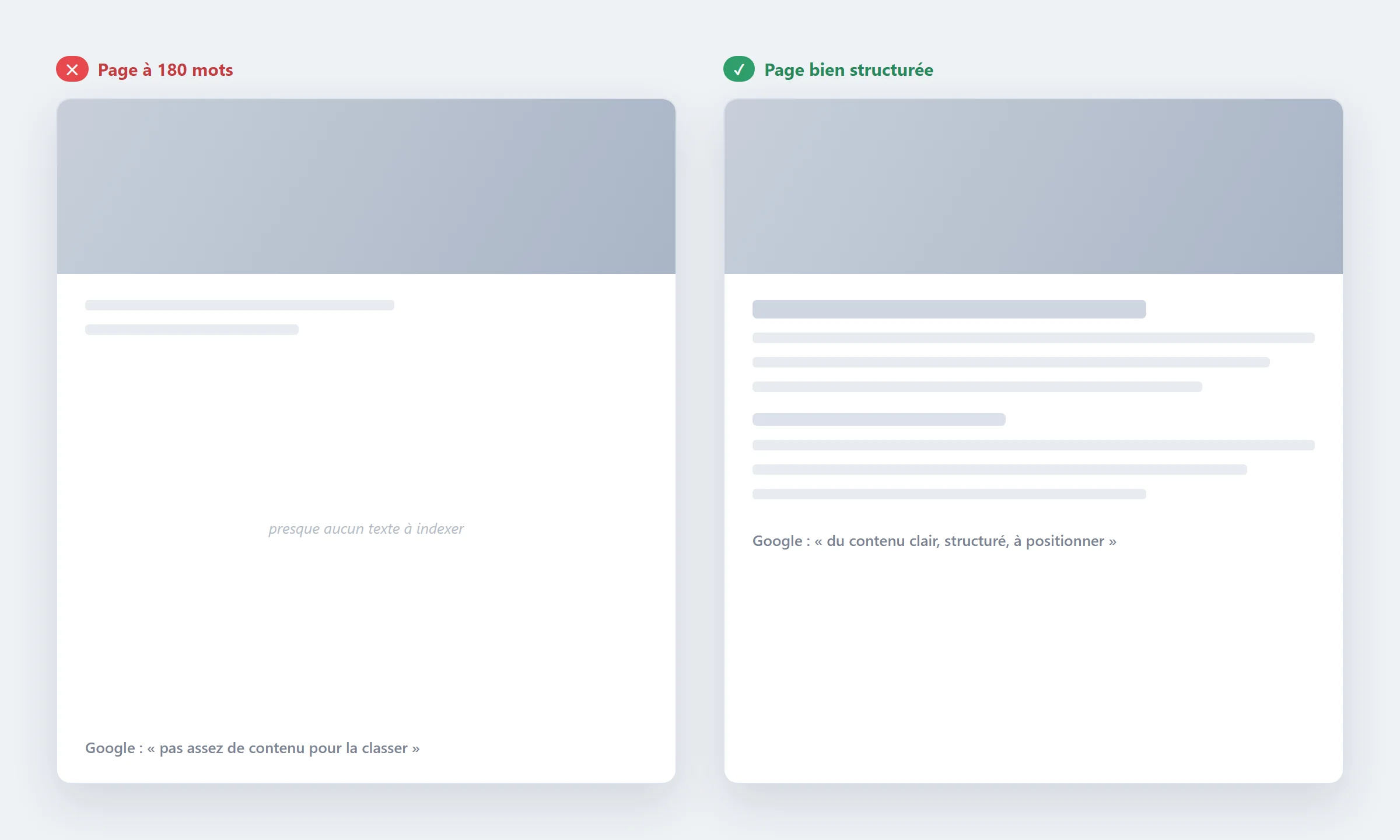
An architect's showcase site is often stunning photos and... almost no text. But Google feeds on written content. Without words, it has nothing to index and nothing to serve to searchers.
I've seen homepages with 180 words. Others with 80. At that level, Google simply doesn't have enough to rank you for anything.
The fix: describe your approach, your specialties, the areas you work in, your process. Not to « add volume », but to give Google and your future clients real, useful information.
4. You have no legal notice and no cookie management
It's not just a legal matter (though in Europe, a legal notice and a cookie banner are required under the GDPR). It's also a signal of seriousness. A site with no legal notice, no privacy policy, tells Google and your visitors that this is a neglected, maybe abandoned website.
The fix: add your legal notice, a privacy policy and a compliant cookie banner.
5. Your site breaks on mobile
More than half your visitors arrive from their phone. And Google evaluates your site primarily on its mobile version. A site that overflows, whose menu gets cut off, whose images take 5 seconds to load, gets penalized, and drives your prospects away.
The fix: your site should be designed mobile-first, fast, with optimized images and navigation that works with a thumb.
6. Your content has no structure
Google doesn't read a page like a novel. It looks for hierarchy: the main heading, then subheadings, then paragraphs. When all the text sits at the same level, with no subheadings, it can't understand how your ideas are organized, and it ranks you lower.
The fix: structure your pages with clear subheadings (your services, your approach, your projects, your location).
7. Your site shows signs of neglect
It's the small details that give it away. A « © 2017 » copyright in the footer. A @gmail or generic email address instead of one at your own domain. A broken menu, a technical error message left hanging. I've seen all of this, for real, on the sites of genuinely talented firms.
Each of these details tells a prospect: « this firm doesn't take care of its own storefront ». And an architect who neglects their online image sends a bad signal, in a profession where the visual is everything.
The fix: a professional email address at your own domain, an up-to-date footer, and a site that works from end to end.
In short
If your site doesn't show up on Google, it's almost never a mystery. It's the sum of these mistakes, invisible to you, obvious to a technical eye. The good news: they can all be fixed.
Your work as an architect deserves a storefront worthy of it, one that makes you visible to the clients actually looking for you.
Is your website visible on Google?
I spot the mistakes that keep you invisible, and tell you exactly what to fix.
Get a free diagnosis of your site →